How Kilims Are Finished: A Workshop Visit
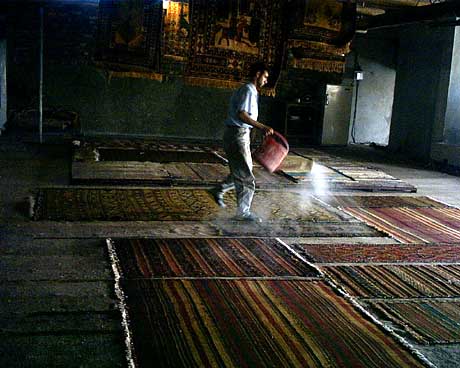
Travels in Iran: The Finishing Stages of a Kilim
A kilim is not complete the moment its last row is woven.
Several finishing stages still lie between the loom and the finished rug.
This photo report records the workshop process we observed in Iran. These are specialist production methods, not instructions for home rug care.
 |

|
| 1. The area where kilims and carpets are washed. | 2. Kilims we purchased wait their turn. |
 |
 |
| 3. First, the kilim is spread out. | 4. A trained worker singes loose surface fibres with a gas burner. |
 |
 |
| 5. Work begins at one edge. | 6. The treatment is applied evenly across the surface. |
 |
|
| 7. The loosened fibres are rubbed away, with the reverse also treated. | |
 |
 |
|
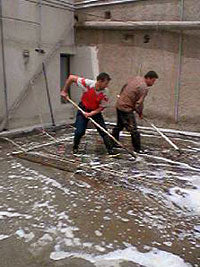
8. Washing comes next. The workshop applies its cleaning solutions. |
9. Both sides are brushed. |
 |
 |
| 10. The kilim is thoroughly rinsed. |
11. A large extractor removes excess water. |
 |
 |
| 12. The kilim is spread out again. | 13. Its shape is adjusted before drying. |
 |
 |
| 14. A taut thread acts as a straight guide as the edges are secured. | 15. The fixing points are closely spaced. |
 |
|
|
16. This is careful, time-consuming work. |
|
 |
|
| 17. A final finishing rinse is applied, and the kilim is left to dry in shape. | |
 |
It was warm enough for a T-shirt in April. Our owner taking a break during the spring 2005 visit. |
| 1. The area where kilims and carpets are washed.
|
2. Kilims we purchased wait their turn.
|
3. First, the kilim is spread out.
|
| 4. A trained worker singes loose surface fibres with a gas burner.
|
5. Work begins at one edge.
|
6. The treatment is applied evenly across the surface.
|
|
7. The loosened fibres are rubbed away, with the reverse also treated.
|
||
| 8. Washing comes next. The workshop applies its cleaning solutions.
|
9. Both sides are brushed.
|
10. The kilim is thoroughly rinsed.
|
| 11. A large extractor removes excess water.
|
12. The kilim is spread out again.
|
13. Its shape is adjusted before drying.
|
| 14. A taut thread acts as a straight guide as the edges are secured.
|
15. The fixing points are closely spaced.
|
16. This is careful, time-consuming work.
|
|
17. A final finishing rinse is applied, and the kilim is left to dry in shape.
|
||
|
It was warm enough for a T-shirt in April. Our owner taking a short break.
|
||
Watching the finishing process revealed just how much work follows the weaving itself.
Even adjusting the shape requires close attention. Beyond the weaver,
many skilled hands contribute to a kilim before it crosses the sea and reaches your home.
More from
>
現地レポート